

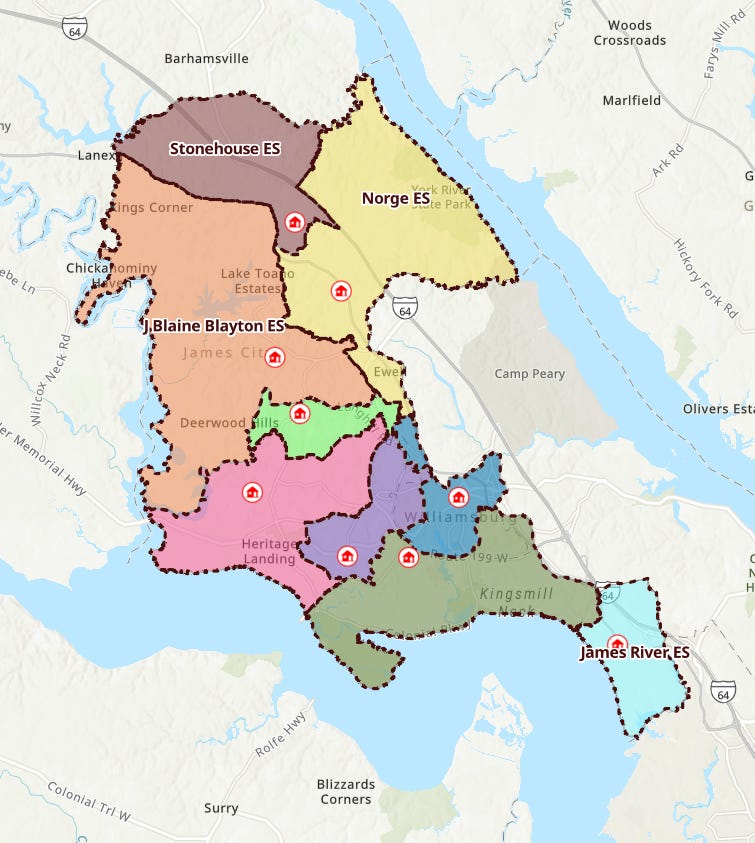
The board of Williamsburg James City County Schools (WJCC) approved new attendance zones for all school levels seven to zero at their meeting on Oct. 20. The board ultimately adopted the redistricted boundaries recommended by Superintendent Daniel Keever, Ph.D. The final plan followed a process that included draft maps, revisions, community feedback and a public hearing, according to the October 20 agenda item.
According to the district’s leadership, the redistricting addresses capacity issues at elementary schools and prepares for two new pre-k centers anticipated to be occupied in August 2027. Administrators noted that eight of nine elementary schools have portable classrooms on site to accommodate student population and that the new pre-k centers will free up space. Yet without redistricting, some elementary schools would remain at or over capacity.
Michael T. Hosang, J.D., District Stonehouse, began discussion of the issue by stating the committee focused on creating a foundation for the district rather than looking at sports teams, many extracurricular activities or specific room counts. Hosang said he and Amy Chen, M.A.T., Parliamentarian, District City of Williamsburg, served on the redistricting committee. The committee was diverse in age, status, sex and race, Hosang said. The committee took the job seriously because members knew the plan would have long-term impact on the community, he said. The committee could not please everyone and did not focus on individuals, Hosang said. The committee focused on doing what was best for the entire district and putting students in the best positions for at least 10 years or more, he said. (0:44:07)


Chen said the committee used an equity lens and balanced guiding principles identified by the community. The committee applied the division’s strategic plan and goals to build and refine new school boundaries, Chen said. Chen said she wanted to recognize miscommunications and misunderstandings in the redistricting process that could have been anticipated, avoided and addressed. Chen said moving forward she hoped for a more empathetic, inclusive and responsive approach. Chen said the community should see a plan with specific allocation of resources, supports, staffing and programs that is research-based with targeted deliverables, action items and accountability measures. (0:49:28)
Kimberley M. Hundley, M.Ed., District Powhatan, said the board has 11,200 children to care about. Hundley said people come with different perspectives and that does not mean everyone’s perspective is wrong. The board had a task to do and members had more in-depth conversations than the public probably has, Hundley said. Hundley said she had faith that the children would help the board in the effort. (0:54:20)


Daniel R. Cavazos, M.D., District Roberts, said he did not have the intimate involvement in the design of the plan that his colleagues on the board had. Cavazos said the electronic designs of the neighborhood borders and the changes, combined with human input to determine the final plan, were very well accomplished by his colleagues, the public and Keever. Each population of interested parties was involved and surveyed, and all questions and comments were looked at and reviewed, Cavazos said. Cavazos said the division has excellent schools and he believed the goal had been achieved with the current redistricting plan. (0:56:21)
Ty Hodges, District Jamestown, said he believed the entire redistricting process would be one of the most challenging and consequential things he would be a part of in his time on the board. Hodges said he had issues with the number of times he heard some people call the proposed plan a return to segregation or an attempt to intentionally turn back the clock on racial equality. That rhetoric was absolute nonsense and harmed their cause and distracted from nuanced discussions the process required, Hodges said. Those accusations were not supported by the facts and diminished the very real injustices of Jim Crow and segregation, he said. Redistricting gives the division a chance to start fresh, to move resources around in a way the division otherwise would not have been able to, and to offset the very real overcrowding already facing some schools, Hodges said. (0:57:23)


Randy J. Riffle, Vice Chair, District Berkeley, said, “we’ve been talking about this for 2 years and then probably longer.” The result of redistricting is because the division is getting two new pre-k centers, Riffle said. Opening new slots in pre-k while still changing the teacher to student ratios later on in elementary level schools is a tough commitment, he said. Riffle said some people were getting a bit less than others and some were getting more. This is the beginning, and there is a lot of work after this that is not really considered, Riffle said. (1:01:22)
Andrea M. Donnor, Chair, District City of Williamsburg, said she wanted to thank citizens who participated on the committee. Donnor said it was disheartening to see vitriol turned on fellow citizens who were just parents, community members and teachers on the committee. Donnor said the board is committed to some of the things Chen outlined that the board is asking for in the budget. The board supports Keever’s vision around what the division could look like, Donnor said. The next set of things is looking at what programming can be input, looking at building a CTE center and making this a premier school division, she said. (1:04:51)
The board voted to approve the redistricted school division attendance zones. Hosang, Hundley, Riffle, Cavazos, Chen, Hodges and Donnor each voted aye. (1:07:44)
We’re committed to keeping local news accessible for everyone. EMAIL us for a free all-access subscription, for any reason, no questions asked.