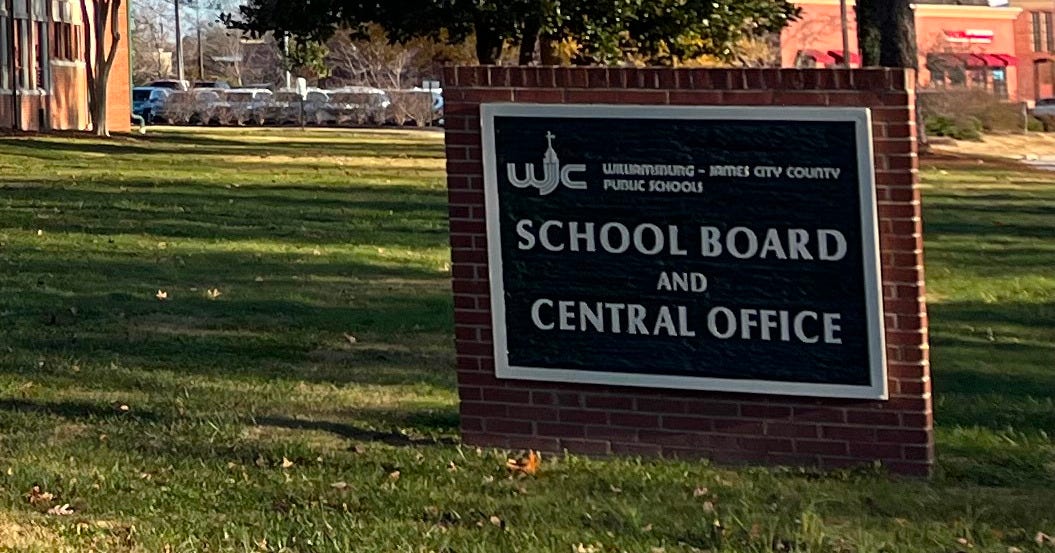
Costs for WJCC Schools Outpace Planned FY27 Funding Growth
Funds specified by division's new joint operating contract still fall short of requested budget by almost $2M despite significant cuts

Later this week, the Williamsburg–James City County School Board will join the James City County Board of Supervisors and the Williamsburg City Council for a joint meeting where Superintendent Dr. Daniel Keever is expected to formally present his proposed FY 2027 operating budget, a $220.9 million spending plan that represents a $13.2 million increase over the current fiscal year.
The proposal, previewed during a recent School Board work session, reflects updated financial assumptions and a more constrained approach than earlier drafts, significantly narrowing the projected funding gap while aligning with the parameters of the new Joint School Operations Contract.
Budget Overview
The proposed FY27 budget assumes a combined $10.6 million increase in revenue, including $6 million from local contract funding floors and approximately $4.6 million in additional state revenue. Needs-based expenditures are projected to increase by $12.6 million, largely driven by compensation, health insurance, and staffing priorities.
After identifying roughly $2.2 million in internal savings—through staff attrition, reduced Virginia Retirement System rates, and departmental cuts—the division projects a remaining $1.92 million shortfall. That amount is categorized as a contingency gap and would be requested as “above and beyond” funding from James City County and the City of Williamsburg.
Board members noted that the projected shortfall has been reduced significantly from the $3 million to $5 million range discussed earlier in the budget cycle.
Snapshot: Williamsburg-James City County Public Schools community data as of Nov. 2025
Schools: 16 total (3 high, 4 middle, 9 elementary, 1 Pre-K)
Enrollment: 11,146 K-12 students; 339 Pre-K students
Student Demographics: White 51.9%, Black 18.4%, Hispanic 17%, Two or more races 9.8%, Asian 2.6%, American Indian/Alaska Native 0.3%
Student Groups: Economically disadvantaged 3,637; Special Education 1,884; Gifted 1,750; English Learners 1,027
Staff: 1,989 total; 1,027 teachers
Teacher Credentials: Master’s 61.8%, Bachelor’s 36.8%, Doctoral 1.2%; 49 National Board Certified teachers
Unfunded Needs
In addition to the contingency gap, administrators clarified that approximately $5 million in operational “unfunded needs” were removed entirely from the budget proposal before it was presented to the Board. These items are separate from the $1.92 million shortfall and represent requests that were deemed unaffordable under current revenue assumptions.
While addressing the School Board recently, WJCC Chief Financial Officer Rene Ewing explained that many of these requests carried over from the FY26 budget cycle but could not be included due to constraints imposed by the joint funding agreement and state revenue estimates. Ewing noted that while departments consider these items “vital,” they could not be advanced without exceeding available revenues. The excluded items from the FY27 budget include:
Additional Staff: Requests for approximately 31 additional full-time equivalent positions, estimated at more than $1.67 million, were excluded. This includes 26 school-based positions (about $1.26 million) and five central support positions (about $410,000). These requests are separate from the 27 positions included in the proposed budget.
Stipends and Contract Adjustments: While the proposed budget includes nearly $1 million for stipend updates, an additional $635,700 in requested stipend enhancements and $165,000 in other contract-related changes were removed from consideration.
Deferred Compensation Increases: The FY27 budget allots $3.4 million for wage increases, but defers another $3.4 million to FY28.
Compensation Strategy
Based on the Superintendent’s Proposed FY 2027 Operating Budget, personnel costs—salaries and benefits—account for approximately 87% of the operating budget, highlighting the division’s focus on retention over flat cost-of-living increases. Rather than replacing raises, the budget combines a 2% base salary increase (~$2.6 million) with $3.4 million for Year 2 of the Bolton compensation study to address pay inequities and market gaps. A flat 1% raise alone would cost roughly $1.3 million.
For teachers, $4.42 million funds the instructional scale, providing a 2% base raise plus study adjustments for average increases of 4.5–5%. Step progression improvements are included, with a minimum increase of 0.5% between steps, supporting retention after 137 instructional staff left in 2025, nearly half within their first 10 years.
Support and administrative staff receive $1.86 million, combining a 2% base increase with a 1.5% study adjustment (total 3.5%). Funds support career progression for custodians and mechanics, reclassification of data entry roles to administrative assistants, and clearer role definitions.
Special education investments total $1.24 million, including $601,000 in pay supplements and $640,000 to extend daily hours for 48 related services staff. These measures aim to retain staff internally and reduce reliance on contracted services, which currently cost around $840,000.
Staffing Additions
Though not all requests for additional staff were included, the FY27 budget does fund approximately 27.0 new full-time employees (FTE), including transitions from expiring funding and new positions to address evolving student needs. Of this total, 13 FTEs are existing employees being moved into the local funding stream. The remaining positions reflect new investments to meet student needs. Key targeted roles include 4 elementary behavior support assistants, 1 gifted resource teacher, 2 school security officers, and 1 elementary math coach.
These staffing decisions align with the Superintendent’s “Human Capital” priority and the Elevate 28 initiative, focusing on retention, role clarity, and addressing critical student supports. While overall enrollment is flat, the budget recognizes growing behavioral, mental health, and specialized learning needs, ensuring that the division maintains adequate staffing to meet evolving educational priorities.
Board Feedback and Next Steps
Board members generally expressed support for the Superintendent’s latest proposal, describing it as disciplined, transparent, and student-centered. Several members emphasized that the remaining $1.92 million contingency gap reflects optional or programmatic items—such as JROTC and lacrosse—that would only be funded if additional local support is approved.
A public hearing on the proposed budget is scheduled for February 17, 2026, with final Board action expected in March. The School Board must submit its funding request to the James City County Board of Supervisors and the Williamsburg City Council by April 1. If adopted, implementation of compensation and organizational changes would occur in phases through June 2027, consistent with the Superintendent’s transition plan.
The writer used AI tools and these sources:
Video - WJCC School Board Budget Work Session - January 13, 2026
Contract for the Funding of the Joint School System for James City County and Williamsburg City
Superintendent’s Transition Plan Priority Action Steps (November 2025 – June 2027)
Other ways to support the Williamsburg Independent …