WJCC Needs $200M over 10 Years for School Maintenance, Expansion, Other Facilities
Superintendent's forecast prioritizes items like HVAC systems, roofs and flooring; also proposes new technical education center and renovated central office building

Earlier this month, the Williamsburg-James City County School Board, James City County Board of Supervisors, and Williamsburg City Council met to discuss various issues facing the school system. At the meeting, attendees were briefed on the school system’s proposed Capital Improvement Plan (CIP) for fiscal years 2027 through 2036.
The 10-year plan outlines nearly $200 million in capital projects mostly aimed at maintaining and expanding existing facilities and programs. The recommended five-year portion of the plan covering FY27 through FY31, totals $107.5 million, with $102.2 million requested from James City County and $5.3 million from the City of Williamsburg.
While funding for previously agreed upon projects will proceed as planned, the recently signed, new school agreement between James City County and Williamsburg stipulates a new method for determining how capital costs are funded going forward. The costs to maintain facilities that support system wide operations such as bus depots and facilities will continue to be shared by both jurisdictions. But funding the maintenance and construction of schools within their boundaries will be each jurisdictions’ sole responsibility.
Thirteen of the system’s sixteen schools are within James City County and long-term projections for FY32-FY36 peg needed upgrades and maintenance at those schools at over $50 million. The planned capital expenses for schools within Williamsburg’s boundaries during that time are only expected to total $500,000 for new paint and carpet at Matthew Whaley Elementary School.
The school system estimates that there will be over $40 million in division-wide capital improvement needs over the next ten years. The plan also includes $15.4 million to renovate the existing Central Office facility in Williamsburg.
The superintendent’s plan anticipates needs over the next decade, though it notes that the city and the county each adopt 5-year capital improvement plans, but only appropriate the funds on an annual basis. This means that although the ten year plans are approved by the school board, the city and county will make the actual funding decisions every year.
Replacement/Refurbishment Cycles
The WJCC School Division relies on established replacement and refurbishment cycles to guide long-term facility planning and determine which projects appear in the later years of its 10-year Capital Improvement Plan. While these timelines provide a consistent framework for planning, school officials cautioned that broader economic conditions and market volatility can significantly affect project costs.
Refurbishment (Paint and Carpet) – 10 years
HVAC – 20 years
Roof – 20 years
Walk-in Coolers – 20 years
Refurbishment (Tile) – 20 years
Generators – 20 years
Tennis Courts – 20 years
Track Surfaces – 20 years
Gymnasiums – 25 years
Auditoriums – 25 years
Metal Roofing – 30 years
System enrollment drives needs
According to discussion at the meeting, the school system has seen an overall decline in number of student, which has prompted a pivot in the focus of capital planning away from capacity expansion and toward maintenance and programmatic needs. Total enrollment for Fall 2025 was 11,146, which was less than the system’s lowest projection and reflected an overall decrease of 233 students from the previous year. Decreases were noted at both the middle school (-129 students) and elementary level (-134 students).
Middle school capacity is projected to remain below 90% and elementary capacity is projected to stay below 82% (after new Pre-K centers open) until beyond 2036. Accordingly, additional construction at James Blair Middle School and the construction of a 10th elementary school are not expected to be needed within the next decade, as
However, despite this overall excess capacity, specific elementary schools like Matthew Whaley and Stonehouse are anticipated to be over 100% capacity in FY28 without intervention, necessitating an elementary-level redistricting process to utilize the division’s total capacity effectively. Officials acknowledged that enrollment numbers could change due to residential development, meaning the capacity decisions must be re-evaluated annually.
High School plans
High school planning within the proposed CIP focused heavily on shifting priorities from capacity expansion to enhancing programmatic offerings, especially for workforce readiness. High school enrollment for the current year (Fall 2025) was 3,804, slightly below the low projection but an increase of 30 students compared to the previous year, with overall high school capacity currently at 96%. Notably, previous plans for capacity expansions at both Jamestown and Warhill High Schools have been redefined as programmatic expansions.
The most significant project reflecting this change is the proposed Career and Technical Education (CTE) Center at Warhill High School (Design FY30; Construction/FFE FY31), intended to expand workforce training options locally, addressing limited student access to regional New Horizons programming due to available seats or travel time
Warhill High School — Total: $29, 239,000
The school division seeks to improve workforce readiness for high-demand trades such as HVAC, plumbing, electrical work, welding through a proposed $12.65 million Career and Technical Education Center. The facility is currently planned as part of the Warhill High School campus and its costs are included in the listed total for Warhill High.
Replace Generator – FY27 – $200,000
Replace Tennis Courts – FY28 – $653,000
Replace HVAC (Design FY28; Construction FY29) – FY28–FY29 – $14,800,000
Auditorium Refurbishment – FY32 – $686,000
Gym Refurbishment – FY32 – $250,000
Career & Technical Ed Center – Design, Construction & FFE – FY30-FY31 – $12,650,000.
Jamestown High School — Total: $22,762,000
The planned expansion of Jamestown High School has shifted from increasing overall capacity to supporting programmatic needs, reflecting data showing high school utilization at 96% and projected to decline over the next decade. As a result, the expansion is scheduled for the later years of the 10-year CIP, with about $9.7 million allocated for design in FY32 and construction and furnishings in FY33. This investment is part of a broader $22.76 million plan that also includes interior refurbishments, HVAC and roof replacements, and a recently completed cafeteria expansion in 2025.
Partial Roof Replacement (Kitchen, Café, Arts Hallway) – FY27 – $805,000
Repaint Interior & Replace Carpet – FY30 – $2,362,000
Auxiliary Gym HVAC (Design & Construction) – FY31–FY32 – $2,200,000
Auxiliary Gym & Gym Roof (Design FY31; Construction FY32) – FY31–FY32 – $886,000
Capacity Expansion – Design, Construction & FFE – FY32-FY33 – $9,709,000
Auditorium Refurbishment – FY32 – $686,000
Gym Refurbishment – FY32 – $250,000
Replace Floor Tile – FY34 – $5,270,000
Replace Tennis Courts – FY36 – $594,000
Lafayette High School — Total: $15,103,000
Repaint Interior & Replace Carpet – FY28 – $880,000
Gym Refurbishment – FY29 – $1,100,000
Replace Generator – FY29 – $62,000
Replace HVAC (Design FY33; Construction FY34) – FY33–FY34 – $7,082,000
Replace Floor Tile – FY34 – $5,979,000
Middle School plans
Middle school facilities and enrollment were a key topic during the CIP discussions, primarily informing capacity decisions for the upcoming decade. The current middle school enrollment is 2,552 students, marking a decrease of 129 students compared to the previous year. Overall middle school capacity is calculated at 82% and is not expected to reach 90% until beyond the next 10 years. Consequently, officials determined that Phase Two of James Blair Middle School would not be needed until beyond the current 10-year plan, though this will be re-evaluated annually as new enrollment data becomes available.
Specific maintenance projects are planned for existing middle schools, including HVAC replacement projects at Lois S. Hornsby Middle School (FY30 & FY31) and Toano Middle School (Design FY32 & Construction FY33). Additionally, the construction of turf at Cooley Field (FY27) is expected to provide instructional space for the James Blair Middle School Health and Physical Education Department.
Hornsby Middle School — Total: $14,282,000
Repaint Interior & Replace Carpet – FY27 – $598,000
Bus Canopy – FY28 – $545,000
Activity Track – FY28 – $264,000
Replace Vinyl Tile – FY30 – $361,000
Repair Observation Deck – FY30 – $334,000
Replace Generator – FY30 – $70,000
Replace HVAC – FY30–FY31 – $9,586,000
Replace Roof (Partial) – FY31 – $1,924,000
Gym Refurbishment – FY35 – $300,000
Auditorium Refurbishment – FY35 – $300,000
Toano Middle School — Total: $10,218,000
Gym Refurbishment – FY28 – $265,000
Activity Track – FY28 – $264,000
Repaint Interior & Replace Carpet – FY28 – $500,000
Replace HVAC - FY33–FY34 – $5,220,000
Replace Roof – FY33–FY34 - $1,927,000
Replace Rubberized Floor Tiles – FY34 – $1,792,000
Auditorium Refurbishment – FY34 – $250,000
Berkeley Middle School — Total: $825,000
Activity Track – FY28 – $365,000
Replace Vinyl Tiles – FY30 – $460,000
James Blair Middle School — Total: $763,000
Activity Track – FY28 – $253,000
Repaint Interior & Replace Carpet – FY29 – $510,000
Elementary School plans
Elementary school planning in the CIP is centered on maintaining existing buildings and strategically managing enrollment changes stemming from new programs. Current elementary enrollment is 4,790 students, reflecting a decrease of 134 students from the previous year. Based on projections, the school division determined there is not a foreseeable need for a 10th elementary school within the 10-year plan.
However, the anticipated opening of new Pre-K centers in Fiscal Year 2028 (FY28) means the division will initiate an elementary-level redistricting process to utilize existing capacity and improve feeder patterns. Without this redistricting, elementary schools like Matthew Whaley and Stonehouse are anticipated to be over 100% capacity in FY28
Stonehouse Elementary School — Total: $10,613,000
Replace HVAC (Design FY27; Construction FY28) – FY27–FY28 – $6,320,000
Replace Roof – FY27 – $3,325,000
Replace Vinyl Tiles (Corridors) – FY29 – $468,000
Repaint Interior & Replace Carpet – FY33 – $500,000
J. Blaine Blayton Elementary School — Total: $9,027,000
Replace HVAC – FY30–FY31 – $7,556,000
Replace Vinyl Floors – FY31 – $177,000
Replace Roof (EPDM) – FY31 – $65,000
Replace Generator – FY32 – $79,000
Gym Refurbishment – FY35 – $300,000
Repaint Interior & Replace Carpet – FY36 – $850,000
James River Elementary School — Total: $8,707,000
Gym Refurbishment – FY30 – $250,000
Replace HVAC – FY32–FY33 – $5,786,000
Repaint Interior & Replace Carpet – FY33 – $350,000
Replace Generator – FY34 – $60,000
Replace Roof - FY35–FY36 – $2,261,000
Clara Byrd Baker Elementary School — Total: $6,234,000
Replace HVAC – FY28–FY29 – $3,050,000
Replace Roof (Original Building) – FY28–FY29 – $1,700,000
Repaint Interior & Replace Carpet – FY29 – $1,259,000
Replace Roof (Pre-K Addition) – FY36 – $225,000
D.J. Montague Elementary School — Total: $2,812,000
Repaint Interior & Replace Carpet – FY27 – $451,000
Replace Roof (Design) – FY30-FY31 – $1,329,000
Replace Rubberized Floor Tiles – FY31 – $700,000
Paved Blacktop Space – FY31 – $207,000
Generator – FY35 – $125,000
Matoaka Elementary School — Total: $1,451,000
Replace Generator – FY27 – $120,000
Replace Vinyl Floors – FY29 – $720,000
Replace Roof (EPDM) – FY32 – $361,000
Gym Refurbishment – FY32 – $250,000
Norge Elementary School — Total: $992,000
Bus Canopy – FY28 – $492,000
Repaint Interior & Replace Carpet – FY33 – $500,000
Matthew Whaley Elementary School — Total: $707,000
Paved Blacktop Space – FY31 – $207,000
Repaint Interior & Replace Carpet – FY33 – $500,000
Laurel Lane Elementary School — Total: $207,000
Paved Playground Space – FY31 – $207,000
Central Office & division-wide plans
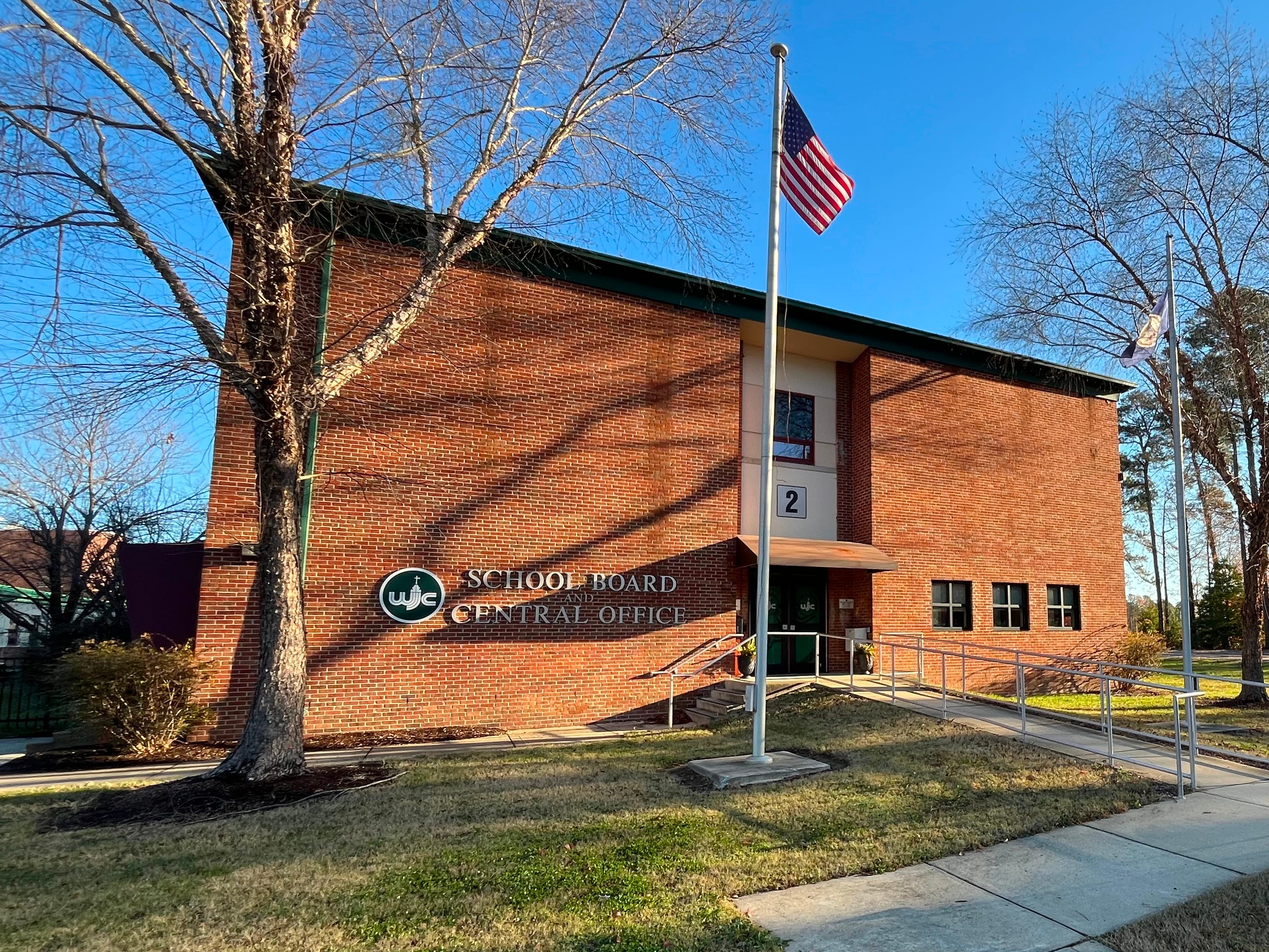
Instead of building a new central office, officials plan to renovate the current 1954 building in FY31–FY32 at a cost of $15.4 million to fix structural problems and modernize the layout. Relocating the office to the new James City County government complex was considered, but leaders emphasized the importance of keeping it centrally located to best serve schools and the community.
The division is also investing in systemwide improvements. Plans include a $6.5 million centralized storage facility in FY28–FY29 to replace inefficient leased space, upgrades to athletic fields and playground accessibility, and continued replacement of school buses as pre-kindergarten programs grow. Ongoing funding supports safety equipment, facility maintenance, and a gradual shift to LED lighting, highlighting priorities of safety, sustainability, and efficiency.
Central Office Refurbishment — Total: $15,400,000
Design: $1,400,000 (FY31)
Construction: $14,000,000 (FY32)
Division-Wide Capital Improvements (FY27–FY36) — Total: $41,322,000
Parking lots, sidewalks, concrete repairs, and brickwork: $375,000 annually; $3,750,000 total
Playground repair and replacement (universal access): $650,000 annually; $6,500,000 total
School bus replacement: Annual costs rising from $1.72 million in FY27 to $2.90 million in FY36; $22,641,000 total
Pre-K bus additions: $506,000 in FY27
Safety and security equipment maintenance: $250,000 annually; $2,500,000 total
Storm drain repairs: $300,000 annually; $3,000,000 total
Fire panel replacements: $325,000 total starting FY29 through FY32
Lighting upgrades to LED: $300,000 annually FY30 - FY36; $2,100,000 total
The writer used AI tools and these sources:
Superintendent’s Proposed Capital Improvement Plan - Fiscal Years 2027-36
School Board’s Adopted Capital Improvement Plan - Fiscal Years 2026-35
School Board’s Adopted Capital Improvement Plan - Fiscal Years 2025-34
School Board Notes – Nov. 11: Capital Improvement Plan, Enrollment Projections
Contract for the Funding of the Joint School System for James City County and Williamsburg City
Other ways to support the Williamsburg Independent:
Share this post!