York seeks to balance boating, business and creek banks with "no wake zone" committee
Application deadline for citizen group next week; formation prompted by boaters and property owners concerned with lack of clarity and problematic enforcement

York County is seeking a balance between maritime activity, local commerce, and shoreline protection through a newly formed advisory committee. The application period for this citizen-led group, the Temporary No Wake Zone Administrative Committee, closes next week on March 27, 2026. This initiative follows a significant turnout of over 100 boaters and property owners who attended a January session to address long-standing issues with local speed restrictions and inconsistent enforcement.
No-wake zones are designated stretches of water where boat operators must reduce speed to the slowest possible pace required to maintain steerage. The goal is to eliminate the wave, or wake, produced by the vessel’s hull, which helps protect shorelines from erosion, preserves sensitive aquatic habitats, and ensures the safety of other waterway users like kayakers or swimmers.
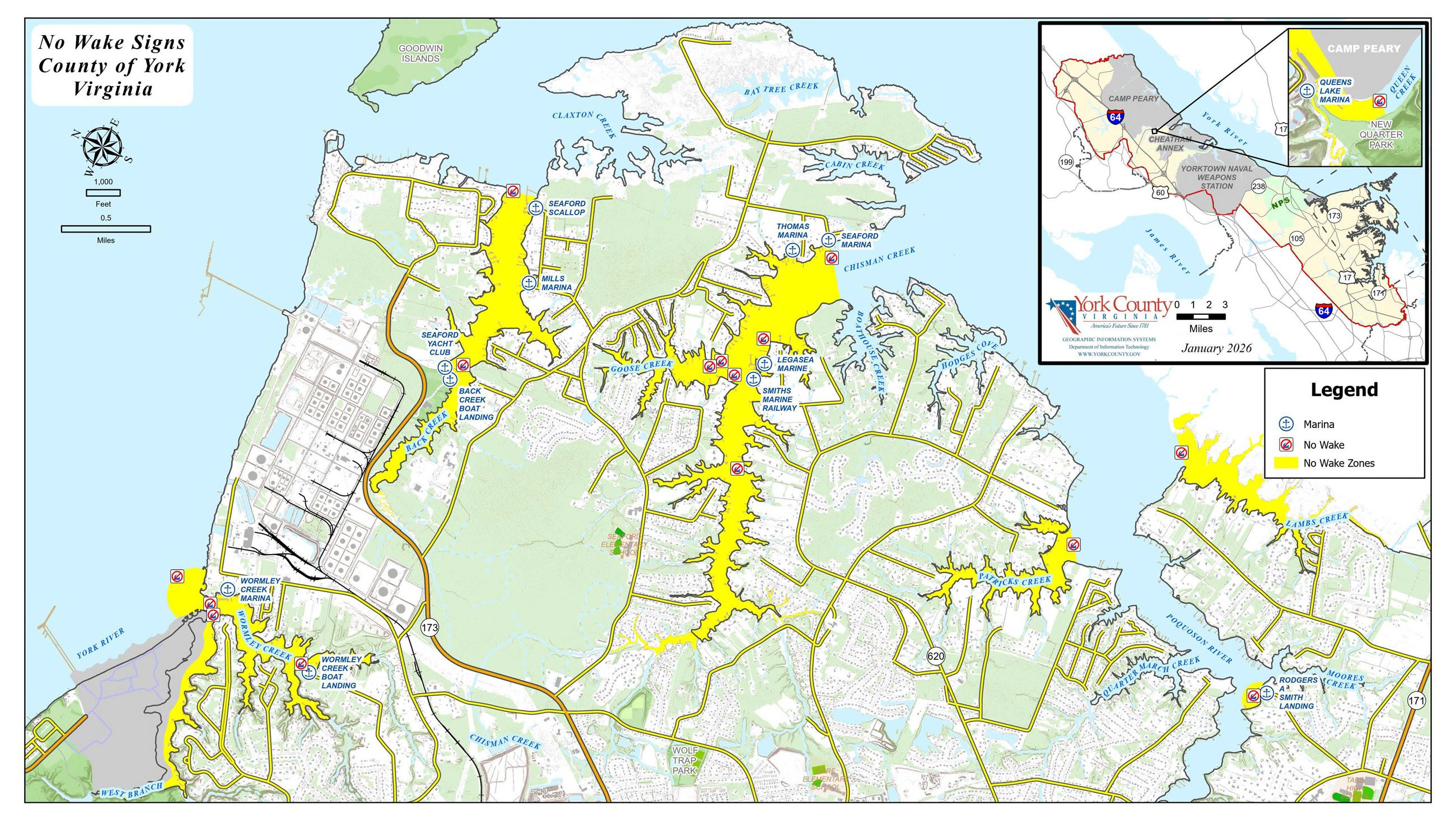
During that meeting at the York-Poquoson Sheriff’s Office, residents and business owners reviewed proposed no-wake zones and shared their concerns regarding ambiguous signage and sudden enforcement. Much of the frustration centered on a controversial sign near the mouth of Chisman Creek, which many noted was difficult to see, leading to unexpected citations for boaters. According to accounts of the meeting, the high level of public concern was unmistakable. For example, when the audience was asked who had attended specifically because of that sign, nearly every hand in the room went up.
This strong response from boaters and property owners prompted the formation of the committee to help the county formalize how these waterway zones are designated and enforced. By consolidating decades of individual ordinances into a single, clear document, the county aims to provide boaters with consistent information and reliable markers. Many attendees have already stepped forward to join the committee, ensuring that the perspectives of the boating community, waterfront residents, and local businesses are reflected in the final regulatory standards. Click here to view the application.
Background on county’s no wake zones
Ongoing discussion about the issue indicates that no wake restrictions in York County were not created all at once. Rather they were established incrementally over several decades, dating back to the 1970s, through a series of separate approvals by the Board of Supervisors and state agencies. The county asserts that it has become difficult for the public and enforcement officers to quickly locate no wake zones due to the patchwork of guidelines.
The Virginia Marine Resources Commission (VMRC) and other agencies hold authority to issue citations for no wake violations on Virginia waterways. Boaters contend that enforcement on several local creeks was sporadic or nonexistent for years. On Chisman Creek, residents asserted that an informal understanding reached in the early 2000s between local stakeholders and state officials effectively put enforcement on hold. When personnel unfamiliar with that informal arrangement recently began issuing citations, boaters who had operated freely in those areas for more than two decades were caught off guard. The resulting complaints prompted VMRC to temporarily suspend issuing no wake tickets on Chisman Creek while the county worked to clarify the regulations.
The ordinances
The county’s proposed ordinance reaffirms eight specific no wake locations in York County, along:
Poquoson River
Chisman Creek
Goose Creek
Back Creek
Queens Creek
Wormley Creek
Patricks Creek
Lambs Creek
County staff explained that the proposed ordinances do not create new no wake zones or expand existing boundaries. Instead, its purpose is meant to compile all legally approved restrictions into one place, establishing a clear legal baseline for both enforcement agencies and the boating public. While addressing the current confusion, officials acknowledged that some existing signs are poorly positioned or in disrepair and committed to having the county assume responsibility for maintaining all physical markers to ensure they remain clearly visible to boaters.
Citizens’ concerns
Comments from attendees at the January session were not universally opposed to no-wake regulations, as board members noted that even those most vocal about the Chisman Creek sign expressed support for restrictions in areas where they are genuinely needed for safety.
The public’s objections centered on three primary issues. First, enforcement arrived suddenly and without warning after years of de facto non-enforcement under what residents described as an informal handshake agreement made with state officials in the early 2000s. Second, the existing sign near the mouth of Chisman Creek sits far off the main channel on the north side of the shoreline, making it invisible to boaters traveling through the center or south side of the waterway. Third, the creek at that location is exceptionally wide, leading residents to question whether a no-wake restriction is necessary there.
By contrast, residents pointed out that deeper into the creek, the channel narrows significantly and is flanked by two shoals. In that section, mixing large and small boats or towing water skiers creates genuine collision and grounding hazards. Attendees broadly agreed that a no-wake zone at that specific pinch point would be appropriate and welcomed.
Supervisors also raised practical concerns about the economic impact of the proposed zones. Forcing boaters to travel at idle speed for the full length of Chisman Creek would result in extremely slow transit times, which could hurt marine businesses located along the water, such as Legasea Marine and Smith Marine Railway, which the county describes as its oldest business. Another notable business that utilizes the creek is Coastal Seaplanes, a regional aviation company owned and operated by seasoned pilot Sam Riggs that offers scenic air tours, charter flights, and customized adventures.
Environmental concerns
Research findings, such as those presented in a 2016 report by the Chesapeake Bay Scientific and Technical Advisory Committee (STAC), confirm that boat-generated waves are a significant contributor to erosion in shallow, narrow tidal creeks. The research highlights that because boat wakes often have greater heights and longer periods than wind-driven waves, they exert a disproportionate impact on the shoreline, especially in areas where wave energy cannot easily dissipate. This process creates a destructive cycle where wake energy strips sediment from the shore and stirs up bottom materials through propeller wash, leading to increased turbidity. This suspended sediment clouds the water, reducing the light availability that is essential for the survival of aquatic life.
Beyond simple erosion, these waves physically degrade vital habitats like salt marshes, oyster reefs, and submerged aquatic vegetation. STAC research indicates that even small waves can destabilize vegetated shorelines and dislodge oysters, while increased cloudiness in the water prevents seagrasses from thriving. The loss of these ecosystems has cascading effects, as they serve as natural water filters, storm buffers, and critical nurseries for fish and shellfish. Ultimately, the fragmentation of these habitats threatens the long-term water quality and biological productivity necessary to support both the environment and local commercial or recreational activities.
Next Steps
The goal is to put county staff, waterfront property owners, and boaters on the Temporary No Wake Zone Administrative Committee. The group is expected to spend up to 12 months evaluating current markers, reviewing community feedback, and developing updated criteria for where no wake zones are appropriate. Its recommendations could result in adding, modifying, or removing specific restrictions.
Any changes the committee proposes will not take effect automatically. Recommendations will be subject to a formal public hearing and will require final approval from both the York County Board of Supervisors and the Virginia Department of Wildlife Resources before implementation.
York County is getting a new Publix, which gets an incentive package to support the project
Williamsburg Independent editor George Arbogust discusses the economic development incentive package between the York County Economic Development Authority and Publix. The agreement, unanimously approved by the York County Board…
The writer used AI tools and these sources:
News Release: York County Clarifies “No Wake Zone” Regulations
No Wake Committee Now Forming (YouTube transcript from “YorkCountyVirginiaUS”)
Memorandum: No Wake Zones and Markers in York County Waterways (February 10, 2026)
STAC – Chesapeake Bay Scientific and Technical Advisory Committee Website
Other ways to support the Williamsburg Independent:
Buy me a coffee: ko-fi.com/williamsburgindependent
Donate on PayPal: paypal.com/ncp/payment/2L8DQJ62CWGRS
Go shopping: etsy.com/shop/dogstreetpress
Read a book: bookshop.org/shop/independentbookshop
Facebook: facebook.com/williamsburgindependent/
Twitter: x.com/WburgIndie
YouTube: youtube.com/@WilliamsburgIndependent