Williamsburg/W&M work to improve off-campus housing conditions
Long-planned Rent Ready program could be approved soon, clearing way for landlord incentives, including higher occupancy and official marketing efforts

The City of Williamsburg is preparing for a vote in March on “Rent Ready Williamsburg,” a certification program focused on improving the conditions of off-campus student housing near the College of William & Mary campus. While State code requires that landlords provide “fit and habitable” housing, the Rent Ready program seeks to ensure quality standards through a voluntary, incentive-based system for landlords that emphasizes property maintenance as well as other guidelines.
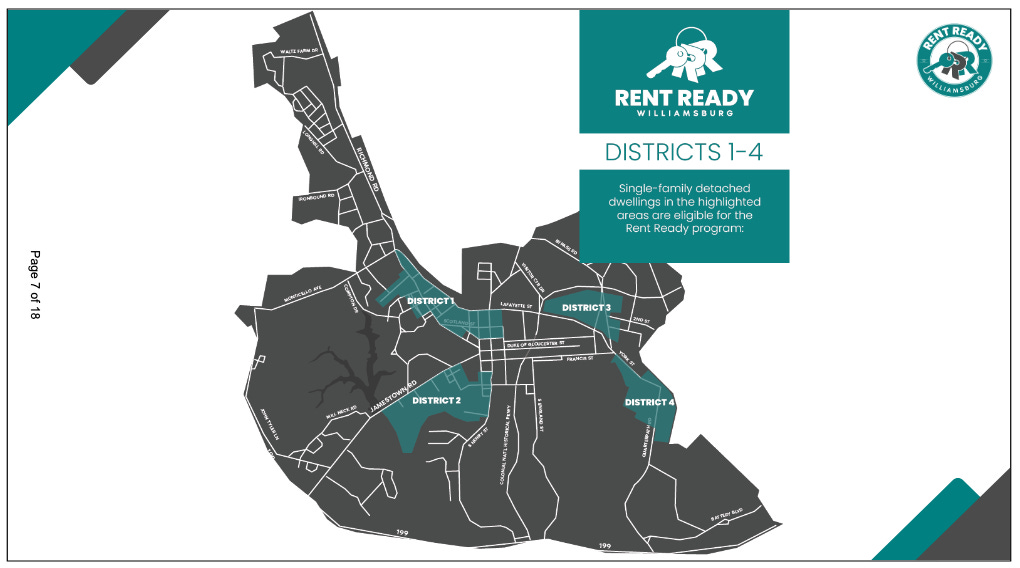
According to the city’s data, 677 single-family homes could be eligible for the Rent Ready program. These properties are spread across four designated rental inspection districts along Richmond Road, Jamestown Road, Capitol Landing Road and Page Street, and York Street residential areas. City officials believe that focusing the new program on these neighborhoods will help students find safer, better-maintained housing close to campus, while easing tensions with neighbors.
“What we’re trying to do is address building safety and quality, to improve communication and cooperation between residents in these neighborhoods, to improve quality, and also to preserve the character of these older established neighborhoods,” said Tevya Griffin, the city’s Planning & Codes Compliance Director, during a presentation given to the City Council at at recent meeting.
Williamsburg Mayor Doug Pons echoed Griffin’s comments. “I hope that a lot of landlords do participate because really this comes down in my mind to providing good quality products for a large segment of our residents … students primarily,” he said. Pons noted that the program will hopefully address some of the issues they face while living off-campus. “Some landlords are without scruples and treat them poorly, have them live in less than safe conditions. I think all of us want that not to be the case,” Pons explained. “So having a program like this which will allow for inspections, which would then allow for better maintenance on some of these properties, makes perfect sense.”
Council members acknowledged at the recent meeting that the Rent Ready program may not check all the boxes for each group of stakeholders, but that they still felt it could deliver positive results. “Is this the answer to everything? Probably not,” said Williamsburg Vice-Mayor Pat Dent. “We’ve probably all missed something along the way or there’s something that can be tweaked to make it better. But I do agree that we need to do something to address the quality of life and safety standards in these properties, and I think this is a good first step and we can always come back and address it if we need to make changes as we move forward.”
The City Council is expected to approve the program in March, giving residents, students, and landlords a few more weeks to submit feedback. More information is available at williamsburgva.gov/rentready or through the Department of Planning and Codes Compliance at the Municipal Building on Lafayette Street.
Rent Ready background
During the recent presentation to council, Griffin noted that the concept for the Rent Ready program dates back to 2019, when the City Council created the Neighborhood Balance Committee to address housing stability in neighborhoods near William & Mary. She explained that a key component of the Rent Ready program is the partnership with the college to promote the participating properties in various channels, including on-campus housing fairs and an affiliated website with current rental listings. “So we really love the program because at the foundation is a collaboration between the university and the City,” she said.

Stakeholders’ feedback
Since the idea’s introduction in 2019, the Rent Ready program has engaged nearly 500 stakeholders — including a survey of 334 students, small group meetings with landlords and neighbors, and public sessions with 117 participants. While 84% of respondents agreed the city needs clear quality standards for off-campus student housing, 59% doubted the program’s effectiveness.
Concerns varied by group. Students flagged financial pressures and safety issues like broken fire alarms. Many landlords felt the program was too demanding, noting that high rental demand makes the city’s proposed incentives less appealing. Neighbors pushed for mandatory rules and strict fines rather than a voluntary, incentive-based approach. Specific needs and frustrations for each group included:
Students: Financial Pressure and Safety Gaps
Financial Hurdles: High monthly rents and large deposits are compounded by non-refundable application fees, which students find predatory when housing isn’t guaranteed.
Living Conditions: Many reported unresponsive “absentee” landlords and a lack of transparency in the rental approval process.
Safety Concerns: Beyond general upkeep, students identified specific risks such as missing or broken fire alarms and poor street lighting on routes between their homes and campus.
Landlords: High Demand and Regulatory Friction
Irrelevant Incentives: The city offered “university endorsement” and marketing help to encourage participation, but landlords noted they already receive inquiries three years in advance and do not need help finding tenants.
Administrative “Red Tape”: Property owners felt the certification process was too complex and that the required education was redundant for licensed real estate professionals.
Request for ROI: Rather than marketing help, landlords indicated they would only find the program viable if it offered financial tax credits or a faster way to increase legal occupancy limits.
Neighbors: Enforcement and Quality of Life
Opposition to Voluntary Rules: Owner-occupants expressed a strong lack of faith in a voluntary system, arguing that only a mandatory, city-wide ordinance would be effective.
Behavioral Enforcement: Neighbors prioritized the regulation of student behavior—specifically seeking strict fines for noise violations, trash, and over-occupancy.
Resistance to Perks: This group explicitly opposed using public funds or city incentives to “reward” landlords for simply maintaining safe properties.
Program incentives
To earn certification, landlords must score at least 80 points on a Quality Assessment covering interior and exterior conditions and available amenities. Both landlords and tenants would be required to complete a “Rent Ready Academy” educational course, and landlords must use standardized leases designed to improve cost transparency. In return, landlords will receive several benefits.
William and Mary endorsement
The program pairs two significant incentives to attract landlord participation. William & Mary formally endorses Rent Ready and will market certified properties directly to students, granting participating landlords access to campus housing fairs and university marketing channels. These features are meant to be a competitive advantage for landlords versus other non-certified properties. Participating landlords will also enroll in the university’s emergency notification system.
Four-Person occupancy
Alongside the university partnership, the program’s most discussed feature is its “Phoenix” rating. Properties that score 95 or higher on the Quality Assessment and maintain that score for one year may qualify to house four unrelated occupants, rather than the three currently permitted under standard zoning, an expansion that can meaningfully increase rental income. Together, these two incentives are designed to make certification financially attractive while also tying higher occupancy limits directly to property quality and management standards.
Under the existing four-person occupancy ordinance, landlords must meet a 2,000-square-foot minimum, have four bedrooms, and provide adequate parking. Only about 195 properties, 29 percent of district homes, currently qualify under those criteria, and just 37 to 38 are enrolled. Rent Ready would shift the model from a dimension-based standard to a performance-based one. Staff initially proposed removing the square footage requirement entirely, which would expand eligibility to roughly 265 properties, or 39 percent of district homes, an increase of about 70 properties. However, several Council members have expressed interest in reinstating the 2,000-square-foot minimum, making it one of the key unresolved questions heading into the March vote.
Modified program requirements
Since its inception, city staff have revised Rent Ready Williamsburg in response to stakeholder feedback. Key changes include reducing the waiting period for the four-person occupancy incentive from four years to one and streamlining inspection requirements, allowing existing federal lead documentation, simplifying asbestos reporting, and clarifying mold and pest standards.
Rejected suggested incentives
During public input, some residents suggested making the program mandatory citywide to ensure consistent standards, while students and renters raised concerns about affordability, including rising rents and nonrefundable application fees, and recommended rent caps or fee limits. Landlords requested tax incentives or financial assistance to offset compliance costs. City staff declined these proposals, noting they fall outside the program’s focus on housing quality and property maintenance. Instead, Rent Ready remains voluntary, offering non-monetary incentives such as eligibility for four-person occupancy and marketing support through William & Mary.
Enforcement and accountability
Enforcement changes limited point deductions to founded violations and provided warnings before penalties. Under the proposed ordinance, certified properties would undergo annual interior and exterior inspections. Tenants may trigger an off-cycle inspection if a landlord fails to address a repair request within seven business days. Landlords who obstruct inspections face a $500 fee, and continued non-compliance results in a one-year disqualification from the program.
Behavioral violations, confirmed by police, fire marshals, or code officers, trigger a point-deduction system. A first violation results in a warning; subsequent violations deduct 10 points from the Quality Assessment score. Properties falling below 80 points enter a three-month probationary period. Those that fail to remediate lose certification for one year, with occupancy reverting to three persons at the next lease renewal to avoid immediate tenant displacement. Confirmed overcrowding violations carry a three-year certification revocation.
Tenants in the new program will bear accountability as well, such as completing Rent Ready Academy before move-in or within three months of occupancy. Failure to comply disqualifies the tenant from future Rent Ready housing and causes the landlord to lose certification for the following year. Confirmed noise, trash, or nuisance complaints also reduce a property’s Quality Assessment score, potentially threatening a landlord’s four-person occupancy status.
W&M off-campus housing website
Along with a variety of educational resources to support students navigating off-campus housing, William and Mary offers both on-campus housing fairs as well as a website with dozens of listings for off-campus options, some available now. Overall, the presents a range of living arrangements, from high-end apartments to budget-friendly shared spaces. Prices typically start around $900 to $1,100 for studios or individual rooms in shared homes, while standard 1- and 2-bedroom apartments generally range from $1,200 to $1,800. Premium developments, such as Governors on North Henry or Manor on the Green, can exceed $2,500 per month.
Location is a primary driver of cost, with several properties like King & Queen Apartments and 718 College Terrace situated within 0.2 miles of campus. Most listings fall within a convenient 1.5-mile radius, though some suburban options extend up to 6 miles away. While many large complexes boast 5-star ratings on the platform, students should note the variety of lease structures available. Options include standard 12-month terms, academic 9-month leases common with Lawson Enterprises, and even short-term monthly rentals. This variety allows students to balance proximity and price according to their specific academic schedules and budgets.
The writer used AI tools and these sources:
Agenda Packet - City of Williamsburg - City Council Work Session - February 9, 2026
Video - City of Williamsburg - City Council Work Session - February 9, 2026
City of Williamsburg Proposed Ordinance to Add Rent Ready Program
Williamsburg webpage: Residential Occupancy Increase in Single-Family Dwellings
City of Williamsburg Adopted Ordinance 21-619 (current 4 person rule)
College of William and Mary website - “Living Off-Campus” guide
Other ways to support the Williamsburg Independent