Annual costs for W&M in-state undergrad will top $46K by 2028; out-of-state over $74K
Despite rising tuition, housing costs and fees, William & Mary remains highly affordable compared to other State schools and prestigious institutions

The College of William & Mary Board of Visitors will hold a public hearing today, Wednesday, April 22 at 5:15 p.m. in Blow Memorial Hall, with an online comment option available, before voting Friday, April 24, to set student rates for the 2026-28 academic years. The university is proposing broad adjustments to balance affordability and access with the resources needed to deliver high-quality instruction, maintain competitive compensation, and fund strategic priorities.
Based on figures provided for the board meeting, the combined total cost for a full-time undergraduate living in a standard double room with an All-Access meal plan would be roughly $45,000 for in-state and around $72,000 for out-of-state students in FY 2027, rising to $46,825 and $74,606 respectively in FY 2028. These totals encompass undergraduate tuition, mandatory Education and General (E&G) fees, mandatory non-E&G fees, room, and board.
Tuition increases expected
Central to the proposal is a 2.9% tuition increase for all undergraduates, applying equally to in-state and out-of-state students in both fiscal years. Full-time undergraduate tuition would rise to $19,734 for in-state and $46,177 for out-of-state students in FY 2027, followed by $20,306 and $47,516 in FY 2028. By Virginia state law, public universities must separate the cost of auxiliary services such as housing and dining from Education and General costs, which cover instruction as well as academic support, student services, institutional support, and plant operations. With state appropriations covering only 15% of the university's annual operating budget, William & Mary relies heavily on tuition revenue, and out-of-state students are particularly critical to financial sustainability, generating approximately 60% of total undergraduate tuition income.
Room & board, fees on the rise
Beyond tuition, the board is also proposing adjustments to mandatory fees and auxiliary services. Mandatory fees would rise 2.6% in FY 2027 and 3.5% in FY 2028, while on-campus students would see room rates increase 6.5% and dining rates rise 6.0% in both fiscal years.
Affordability and financial aid still competitive
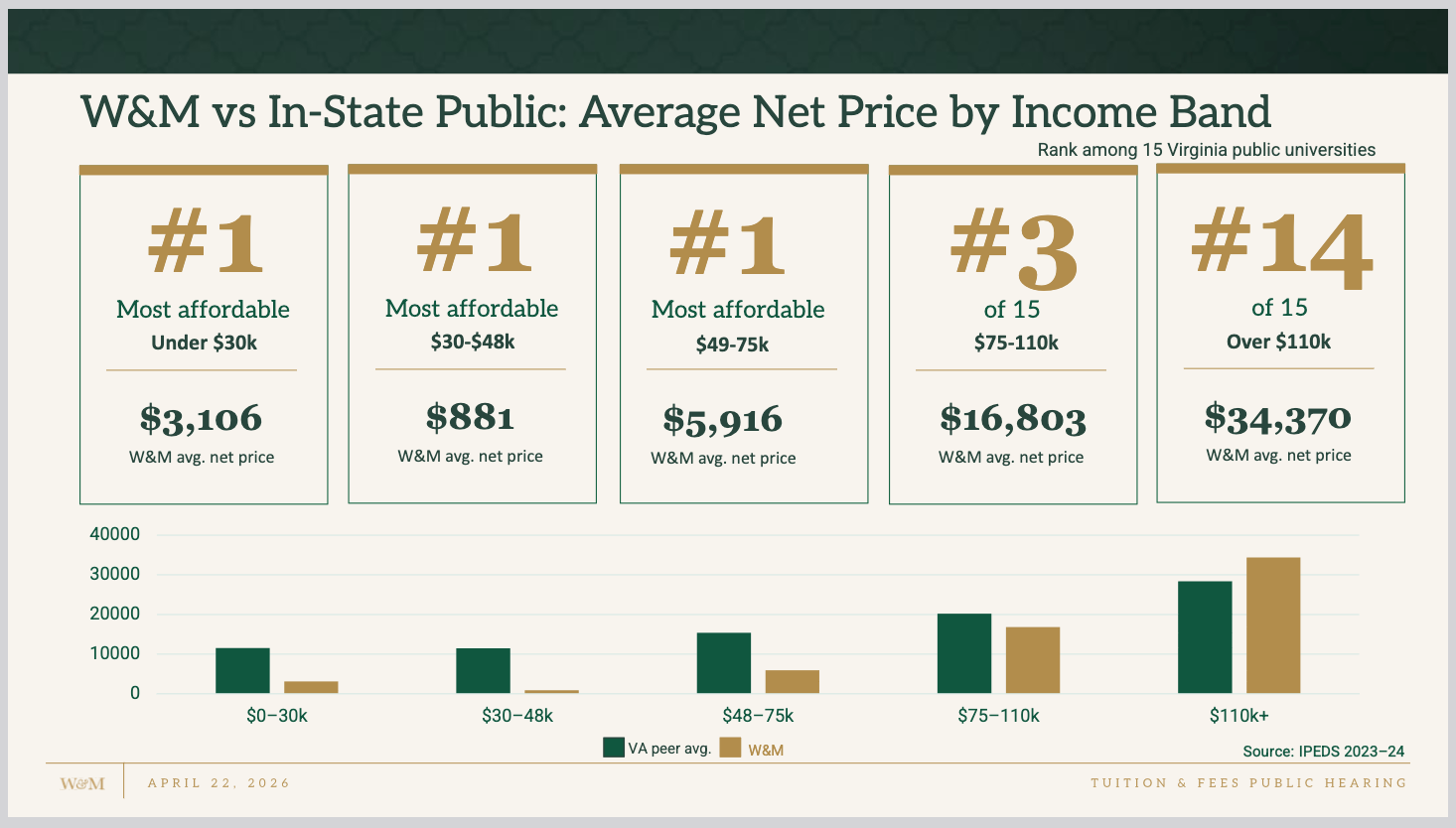
Despite the proposed increases, William & Mary points to a strong record of financial restraint. Following a four-year in-state tuition freeze from FY 2020 through FY 2023, cumulative in-state tuition growth stands at just 10.0%, well below the 27.7% rise in the national Consumer Price Index over the same period. The university meets 100% of demonstrated financial need for in-state undergraduates and ranks as the most affordable Virginia public university for families earning under $75,000. Those efforts have kept debt manageable for graduates, with the median federal student loan debt for the Class of 2025 at $20,500, approximately 20% below the median for all Virginia public institutions.

FY 2027 Operating Budget summary
The FY 2027 operating budget projects total revenues of $618.6 million, up 3.0%, against $616.0 million in expenditures, a 3.4% increase. The budget applies a 5.0% spending rate based on the rolling 12-quarter average of university-held endowments.
Tuition and E&G fees remain the largest revenue source at $271.2 million, essentially flat year over year, while the State General Fund shows the strongest growth, rising 9.2% to $101.7 million. On the expenditure side, academic instruction leads at $179.1 million, followed by Auxiliary Services at $142.6 million and financial aid at $73.4 million.
The Auxiliary Enterprises budget, which covers self-funded operations supporting the broader student experience, generates a positive margin of roughly $3.3 million on $146.0 million in revenues. Student Housing, Intercollegiate Athletics, and Dining Services are the three largest operations, with dining producing the strongest individual margin at $3.0 million.
Keep reading for a more detailed analysis of student costs as well as the college’s operating budgets.
Thank you for reading the Williamsburg Independent! The rest of this post is available to paid-subscribers only.