
Estimated tax revenues from Bluffs of Kiskiack development diverge
James City County concludes planned fixes insufficient for nearby intersection, questions affordable affordable proffers

The Bluffs of Kiskiack, a mixed-use development proposed for northern James City County near the Interstate 64 interchange in Croaker, roughly between Toano and Norge, currently the site of the massive presidential busts known as the Presidents Heads, is now before the Board of Supervisors carrying three big promises from its developer: a financial windfall for the county, fixed traffic problems, and affordable workforce housing. Each promise rests on numbers or mechanisms that the county notes are not guaranteed to hold.
The county's own fiscal model produces wildly different results depending on whose property values are used. The traffic fixes required of the developer do not bring the project's main intersection up to the county's own standard. And the price cap meant to keep new homes affordable is tied to an index that does not guarantee it will stay within federal affordability limits.
Using the county’s standard property assessment figures, the Bluffs of Kiskiack is projected to generate about $7.3 million in net tax benefit to James City County through 2050, or roughly $292,000 a year on average. Run the same model using the assessed values the developer itself submitted, and the number jumps to about $55.8 million through 2050, or about $2.2 million a year.
County documentation attributes the entire gap to that single choice: whether to use the county’s standard default values or the developer’s own higher figures. The gap shows up across every major line in revenue estimates, while expenses differ far less than revenue between the two estimates. :
Property tax revenue: about $32.4 million under the county’s figures versus $79.1 million under the developer’s
Total general fund revenue: about $43.1 million versus $91.8 million
Grand total revenue: about $53.7 million versus $102.7 million
Total operating costs: about $39.3 million versus $39.8 million
Grand total expenditures: about $46.4 million versus $46.9 million
The developer’s higher revenue estimate is built on assessed values of $506,000 for a single-family detached home, $412,000 for a single-family attached home, $565,000 for an age-restricted multifamily unit, and $150,000 for a charitable-donation lot, along with commercial values ranging from $90 to $395 per square foot depending on use. The developer’s Community Impact Statement also points to job creation in senior healthcare, medicine, retail and the planned museum as a financial benefit to the county, though it does not attach a dollar figure to that claim.
Key Takeaways
The Bluffs of Kiskiack development is under county review, with unclear tax benefits, unresolved traffic problems, and housing prices that may not stay affordable:
The tax benefit to the county depends heavily on whose numbers are used
Using the county’s standard home values, the project’s tax benefit is much smaller than using the developer’s own higher values.
The difference between the two estimates comes entirely from which property values are plugged into the county’s calculation.
Planned road fixes won’t bring the main intersection up to standard
The busy intersection at Croaker Road and Rochambeau Drive already struggles with traffic today and is expected to still fall short of the county’s goal even after upgrades.
Several turning movements at the intersection are expected to keep failing, and a fatal pedestrian crash nearby in 2023 was only mentioned at the public meeting, not in official reports.
The affordable housing price limit isn’t fixed in place
The developer promises more affordable homes than the county requires, but the maximum price for those homes changes every year based on a building cost formula, not income limits.
That formula doesn’t guarantee the homes will stay within the price and rent limits the county considers affordable.
Resources: Agenda link | Video link
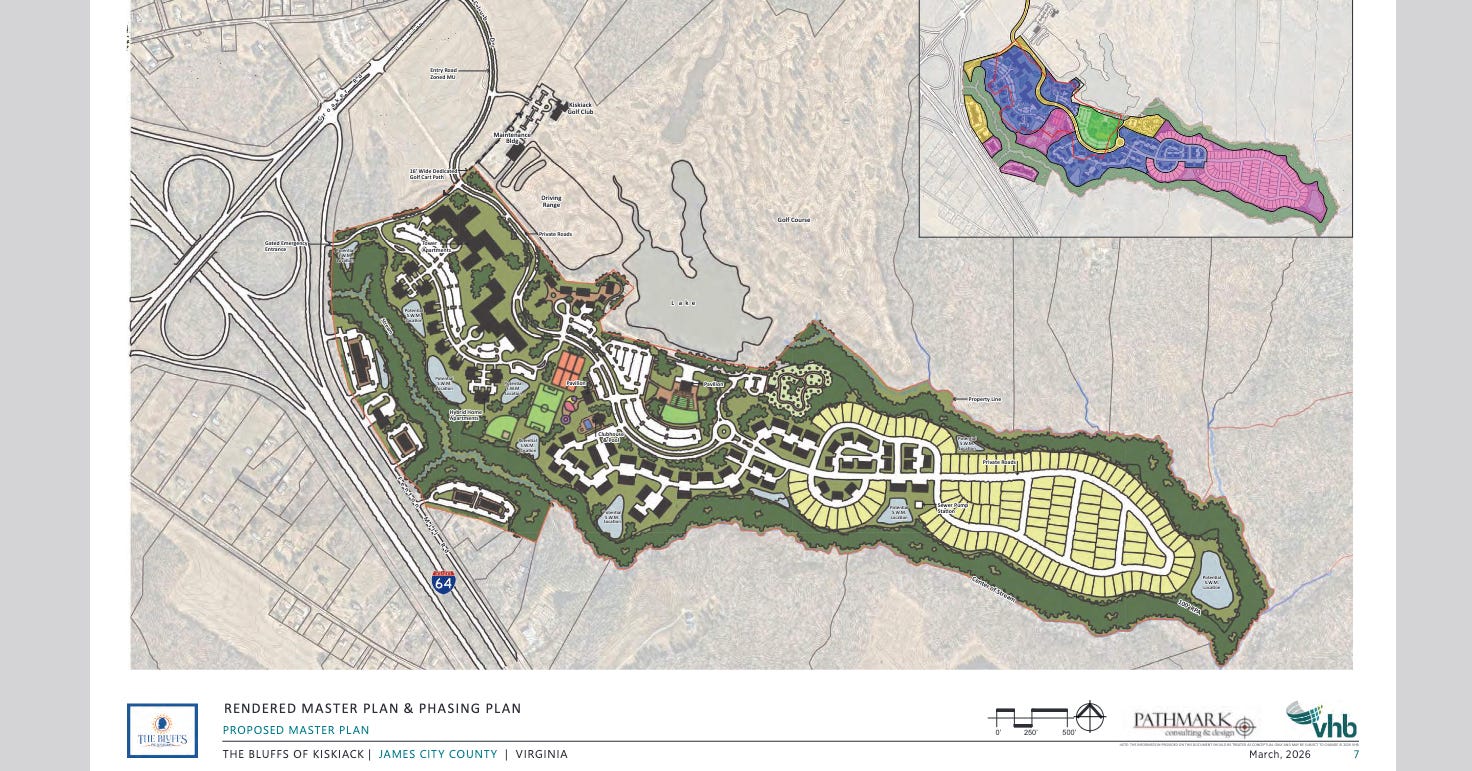
The project concept includes an open-air museum and visitor center for the Presidents Heads, the large presidential bust sculptures stored on the property since the original Presidents Park attraction closed. Unlike potential homes in the development which can’t be occupied until road improvements are built, developers anticipate anticipate that the museum could open once those improvements are planned. The county’s tax model values the museum building at $395 per square foot, the highest of any use in the project. The developer’s Community Impact Statement also cites the museum as a source of local jobs, though it gives no dollar figure.
Road improvements and key intersection
The Croaker Road and Rochambeau Drive intersection, the project’s main access point, already operates at a failing grade today. County standards call for the intersection to reach a grade of A, B or C. Even after the developer completes its required road improvements, county traffic modeling projects it will still operate at a D grade in the morning rush and an E grade in the evening rush, in both 2030 and 2036. Several turning movements are projected to fail outright, including the eastbound, westbound, northbound and southbound left turns and the southbound through movement.
County staff note that the improvements do make the intersection better than it would be without them, and that a planned turn-restriction design and roundabout are meant to address crash patterns identified in the developer’s traffic study. Under the development agreement, those improvements must be built, or guaranteed, before homes can be occupied, with an exception for the museum and visitor center if guaranteed in advance. The road serving the county’s resource-recovery facility must close to the new development once that facility stops operating. All interior roads in the project will be private, maintained by the developer rather than the county.
The developer’s plan adds a turn lane and a flashing yellow arrow at Croaker and Rochambeau, retimes the traffic signal, adds a channelizing island at Fenton Mill Road, and builds a roundabout with a right-turn lane at Croaker Road, Club Drive and Cedar Point Lane. It also includes a private road, a separate emergency access road near a planned fire, rescue and police site, and points to ongoing highway construction on Interstate 64 as adding capacity for both the region and the project. At the Board meeting, county officials disclosed that a pedestrian was fatally struck on a nearby road in 2023, a detail that does not appear in the staff report or the developer’s own materials.
Affordable housing price caps
The developer has proffered that at least 30 percent of single-family homes in two sections of the project will be priced for households earning up to 80 percent of the area median income, exceeding the county’s Comprehensive Plan target of 20 percent. But the maximum sales prices for those homes are set to adjust each year using a national construction cost index, a formula that does not guarantee the homes stay within the income limits set by federal housing rules.
Under the county’s current affordability guidelines, based on a median income of $106,500, homes would need to sell for no more than $107,250 to $421,500 depending on income tier, and rents would need to stay within ranges roughly from $559 to $3,195 a month depending on household size and income level. The project’s residential plan calls for 122 single-family detached homes, 178 attached homes, 384 age-restricted multifamily units and 20 charitable-donation lots, with the affordable share marketed toward teachers, healthcare workers, firefighters, police officers and county employees. Those price ceilings stand in sharp contrast to the assessed home values built into the developer’s own fiscal projections, discussed above.
At the Board meeting, officials also disclosed that two builders are each set to construct 25 homes in the project’s first phase, that the county’s existing housing stock includes 71 single-family homes and 61 townhomes already on the market, and that building a single townhouse costs an estimated $180,000 while preparing a lot costs about $100,000. The average home in the county’s existing housing stock is 23 years old.
Westwood Park developer, James City differ on tax revenue estimate

The James City County Board of Supervisors recently approved the rezoning for Westwood Park, which will bring up to 139 homes and about 24,000 square feet of commercial space to land owned by …

Buy me a coffee | Leave a tip on PayPal | Tees on Etsy