Colonial Williamsburg's new leadership must involve residents in future development plans (OPINION)
Lack of community input early in process undermines Foundation's development plans
This post is opinion and commentary. Don’t agree with it? Or have something else you want to share? Email us at contact@williamsburgindepedent.com.
The sudden retirement of Cliff Fleet as Colonial Williamsburg Foundation President and CEO, with Board Chair Carly Fiorina assuming the role effective immediately, presents a fresh opportunity for the institution to embrace open dialogue with city residents about its long-term development plans. In fact, city officials are already fielding mounting public questions about high-density development and zoning approvals as part of a $600,000 Comprehensive Plan update that will guide decisions for decades to come. Land owned by the CW will be a prominent part of that debate.
Multiple reports over the past year by the Williamsburg Independent regarding potential development of CW property has drawn thousands of readers and significant engagement on social media. I believe this reflects deep, personal interest in how one of the area’s largest landowners manages its property and how involved residents will be in those decisions. The Foundation’s active involvement in the city’s planning process, including having had a representative on the panel that selected the Comprehensive Plan consultants, as well as its receipt of direct city funding and benefit from tax dollars spent on regional marketing, makes the question of public transparency all the more pressing.
Overall, Colonial Williamsburg Foundation owns a substantial portfolio of property in the city, much of which has been identified or discussed for potential redevelopment. These include the 3.9-acre P6 parking lot near Merchant’s Square, the 291-acre Green Course golf course, a 42.3-acre parcel near the Visitors Center area targeted for rezoning, the Franklin Street and Lafayette Street corridor where several older buildings remain following demolition of the Foundation’s administrative offices, and nearly 3.76 acres of vacant parcels at Peacock Hill. Combined, these properties represent hundreds of acres of Foundation-owned land at various stages of development consideration. But no one really knows. And that’s the problem.
Keep reading for more detail about the particular pieces of land and development projects that have been discussed by the Foundation and local officials.
Parking Lot P6

The P6 lot near Merchant’s Square, a full city block in a desirable downtown location, has been identified as a possible development site, though no formal plans are currently in place. According to city assessment records, the parcel spans approximately 3.9 acres, is zoned B-1 Downtown Business, and carries a total assessed value of roughly $6.7 million.
The Green Course

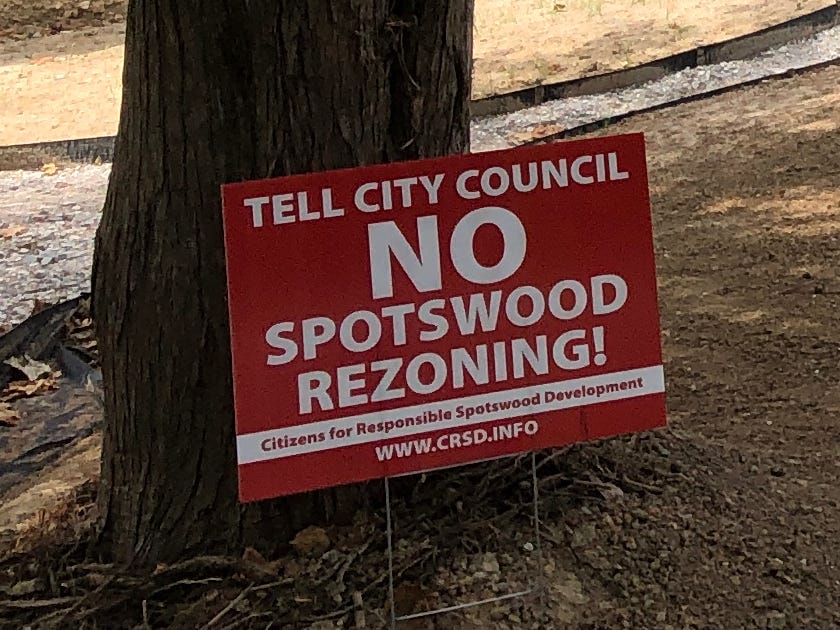
Documents obtained through FOIA requests indicate the Green Course has been discussed as a potential redevelopment site, with a retirement community among the concepts considered. A Foundation spokesperson has since told the Williamsburg Independent there are no current plans to redevelop the course. According to city assessment records, the property spans approximately 291 acres and carries a total assessed value of roughly $8.4 million. Given the Foundation’s failed attempt to redevelop the Spotswood golf course, a process many residents felt lacked public involvement despite government officials having an early role, any future plans for a property this size should include residents from the start.
Visitors Center Area

The Foundation owns a large 40+ acre site at 100 Visitor Center Drive, which is assessed at roughly $1.5 million, including structures, which has been the subject of significant development ambitions. A rezoning request filed on behalf of HTRFA and Colonial Williamsburg sought to transform more than 150 acres in the area into a Recreation and Entertainment District that would have brought 500 multi-family residential units, dozens of townhomes, and 250,000 square feet of research, lab, and retail space. The proposal was withdrawn, though nothing has ruled out a similar effort in the future.
The Historic Triangle Recreation Facilities Authority, which is currently building an $80 million sports complex on Foundation-leased land near the visitors center, has also explored using adjacent Foundation-owned property for a live performance venue. Several years ago, a non-binding preliminary agreement with a contractor was reached but later postponed. Last year, the city attempted to pass $5 million in COVID-relief funds to HTRFA for the venue, but the transfer did not follow proper procedures and the funds were returned. The city’s proposed FY27 budget nonetheless includes a goal to complete initial venue design by July 4, 2026.
Peacock Hill / Childrens’ Park

The genesis of a downtown children’s park dates to 2017, when the Foundation proposed a plaza in the area, sparking public interest in family-friendly spaces downtown. The City has since identified Foundation-owned land at the corner of North Henry and Prince George streets as a potential site, though that same land was once identified as a potential site for new housing. The vacant parcels that make up the site total approximately 3.7 acres with a combined assessed value of roughly $1.8 million. The $6.5 million park, which city officials have been adamant is not a splash park, includes play structures, a carousel, an artistic fountain, and public restrooms. The city’s proposed FY27 budget does not include direct funding for construction, but does carry forward a goal to identify a funding strategy for the project.
Franklin Street / Lafayette Street

The Foundation is currently constructing a new visitor arrival center on the block that previously housed its administrative offices on Franklin Street, which were demolished to make way for the project. A representative of the Foundation recently confirmed to the Williamsburg Independent that completion has been pushed past the original June 2026 target. Several older buildings along Lafayette Street remain, and could be candidates for future redevelopment.
With the Comprehensive Plan process now underway and incremental zoning review on the table, decisions about these properties could have lasting consequences for the shape and character of the city.
The writer used AI tools for this post.
Related reporting by the Williamsburg Independent:
Other ways to support the Williamsburg Independent:
Buy me a coffee: ko-fi.com/williamsburgindependent
Tip on PayPal: paypal.com/ncp/payment/2L8DQJ62CWGRS
Go shopping: etsy.com/shop/dogstreetpress
Read a book: bookshop.org/shop/independentbookshop
Facebook: facebook.com/williamsburgindependent
Twitter: x.com/WburgIndie


